Process X-ray

Your orders wait
somewhere.
Now you see where.

Process X-ray is part of every a-systems system. Each step an order, a purchase or a warehouse transfer takes is recorded the moment it happens: who moved it, and when. One screen then shows where the time goes, the paths your documents really take, how often work is done twice, and how much of it ran with no person at all. Specialist process-mining tools first have to extract this picture from your ERP. Here it is recorded where the work happens.

A quarter of invented orders. You enter as Finance. No call, no card.

Where the time goes Sales orders · 90 days
  • Created→Confirmed0 min
  • Confirmed→Ready to pick0 min
  • Ready to pick→Shipped28 h 52 min
  • Shipped→Invoiced3 h 43 min
  • Invoiced→Paidmost of the time8 d 18 h
The median wait between two steps, on the demo's invented quarter. The pair that holds most of the time is marked.
Started
Documents begun in the period, by flow and by source
Finished
Shipped and paid, received and billed, done on the floor
Start to finish
The median time from the first step to the last
Untouched
The share that finished with no person moving any step
Rework
The share where a step was undone or done again
What it answers

Six questions, answered on one screen.

Pick a flow and a period. Every number opens the list of documents behind it, and every document is a link. Nothing is a sample and nothing is estimated: these are your own documents, counted.

Where the time goes

Which step eats the days between the order and the truck?

Each pair of steps, with the median wait and the slowest tenth. The pair that holds most of the time is marked, so the conversation starts there.

Paths

Do orders follow the process you think you have?

The ten most common sequences of steps, each with its share. Everything else is counted as other paths, never hidden.

Rework

How often is the same work done twice?

An order cancelled and confirmed again, an invoice taken back to draft: counted as rework, with the documents behind the number.

Who moves it

Who actually moves each step?

A person on a screen, a shop or marketplace, a scheduled job, a document rule or the AI. Counted for every step, at the moment it happened.

Untouched

How much runs with no person at all?

The share of finished documents no person touched, shown twice: once with the AI counted as a person, once without.

Three flows

Sales, purchasing and the warehouse floor.

The same five figures for orders, purchases and transfers. Orders split by where they came from: typed by hand, a shop, a marketplace.
The screen

The demo's quarter, as the X-ray reads it.

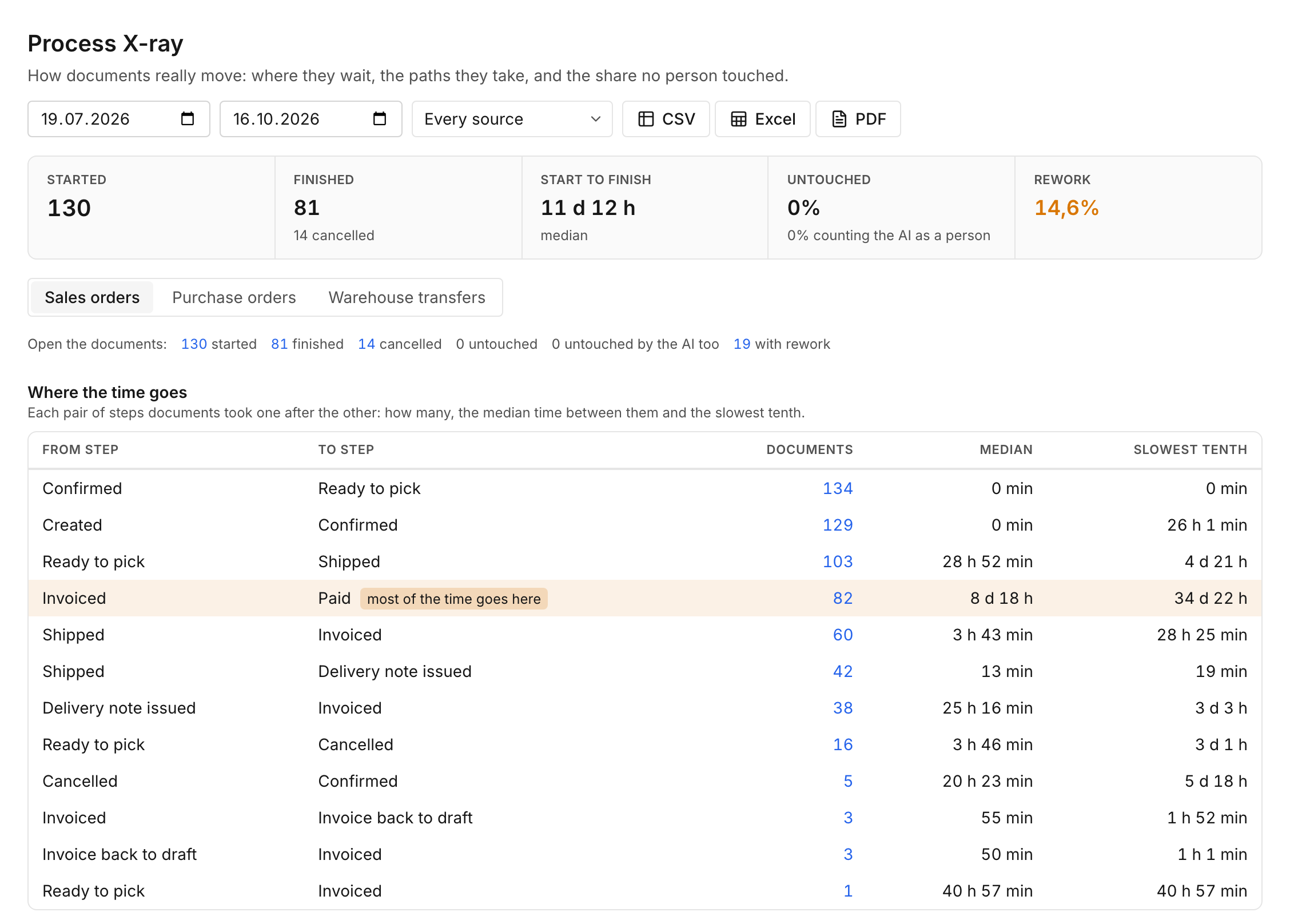
Ninety days of invented trading: orders from three channels and from the sales team, purchases with their receipts and bills, a warehouse that works on weekdays. The X-ray finds what a manager would want to know first: an order spends more than a day between ready to pick and shipped, and the longest wait in the whole flow is customers paying.

Process X-ray of the demo's sales orders over 90 days: five figures, then each pair of steps with its median wait and its slowest tenth, the pair from invoiced to paid marked as holding most of the time
Reports > Process X-ray · sales orders, 90 days · invented data
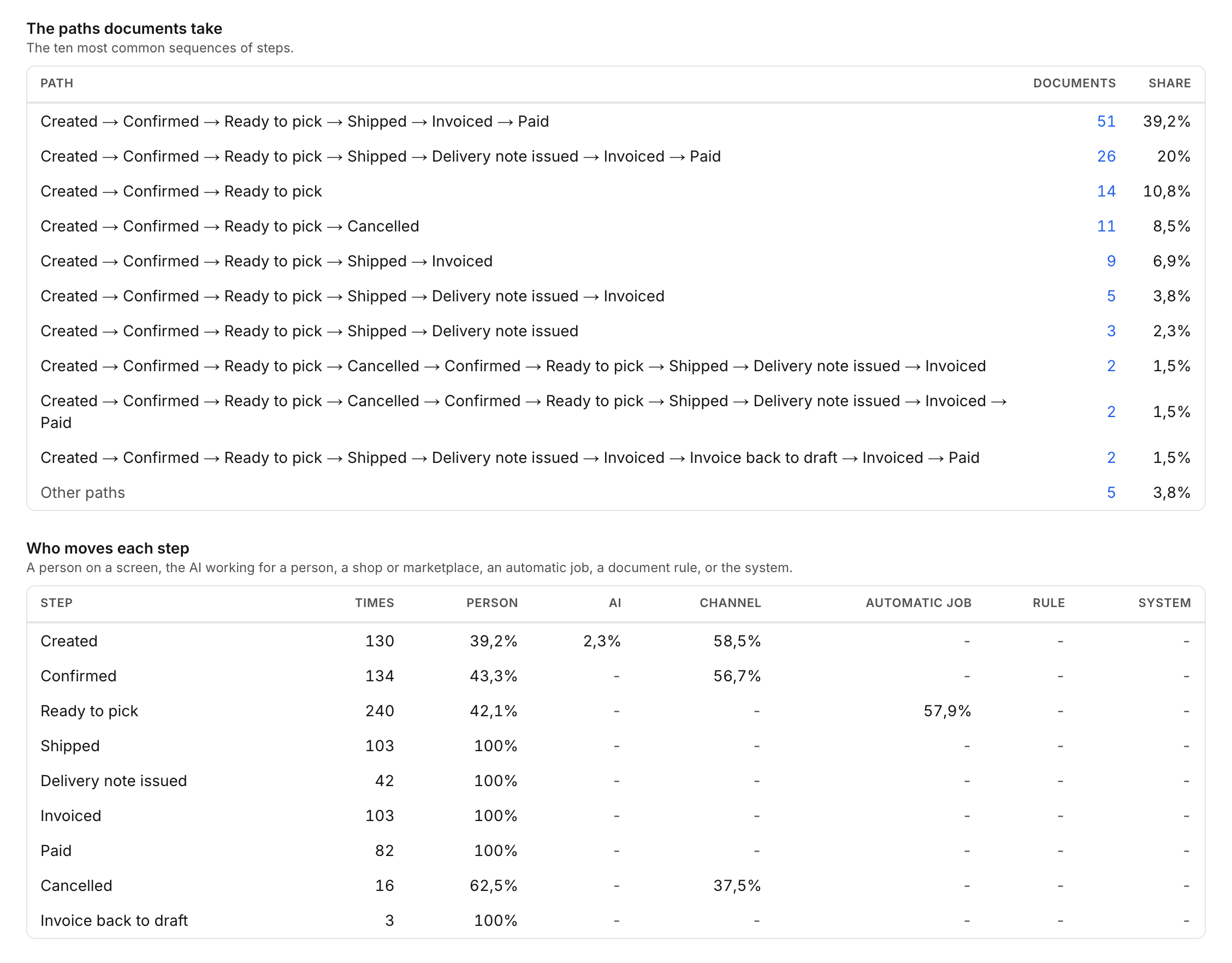
The ten most common paths of the demo's sales orders with their shares, and who moves each step: person, AI, channel, automatic job, rule or system
The paths documents take, and who moves each step · invented data
Why it is different

Recorded where it happens, not reconstructed afterwards.

Process mining usually begins with an extraction project: export the ERP's tables, map them into an event log, and guess who did what from the timestamps. None of that is needed here, because the system that does the work also writes the record.

In the same transaction

Every step is written together with the change

When an order is confirmed, a pick is validated or an invoice is posted, the step goes into an append-only log in the same database transaction. A step that fails leaves no trace, and no step can be rewritten later.

Who, not only when

It knows who acted

A screen counts as the person signed in, a marketplace order as the channel, a scheduled run as the job, a request through the AI door as the AI. A channel's order is never counted as its salesperson's work, so untouched means untouched.

Yours

In your system, on your server

No second licence and no copy of your data in a vendor's cloud. It comes with the system you receive, on your server, with your code. Every list exports to CSV, Excel and PDF.

Straight answers

Five questions people ask about it.

Do we need a data team, or another tool?+
No. It is a report inside the system, for the people who run each flow. Sales sees the orders, purchasing the purchases, the warehouse its transfers, and administrators and finance all three. Nobody builds a model, and nothing is exported first.
What about the months before the system went live?+
When your data moves in, the history is filled in from the records that already hold an exact moment, such as when an order was created or a delivery was done, and it is marked as history. Who moved a step is counted only from the day the log starts, because old records cannot say it. Nothing is guessed.
When does it start showing something useful?+
From the first day the system runs, every step is recorded. A picture worth acting on needs a few weeks of documents, which is why the demo carries a whole quarter. The longer it runs, the more it can tell you.
Can our own AI assistant ask it?+
Yes, where the AI door is switched on: your own Claude or ChatGPT can ask where orders are waiting, with the same rights as the person who connected it. It reads the X-ray and changes nothing.
What does it cost?+
Nothing on top. It comes with the system, which is priced per business flow, not per user. See pricing.

Three minutes in the demo
show a quarter as a process.

Enter as Finance and the X-ray opens on ninety days of sales orders, purchases and warehouse transfers, each with its waits, its paths and the people behind them. Then picture the same screen on your own orders.

Open it in the demo The one-page PDF No call. No card. It opens in thirty seconds.

Which business should the demo show?

Two are open now. The data is invented and rebuilt every few hours. No call, no card.

Next: service companies, clinic groups and schools, on the same foundation.